What KDD Showed Me About Research
KDD 2026
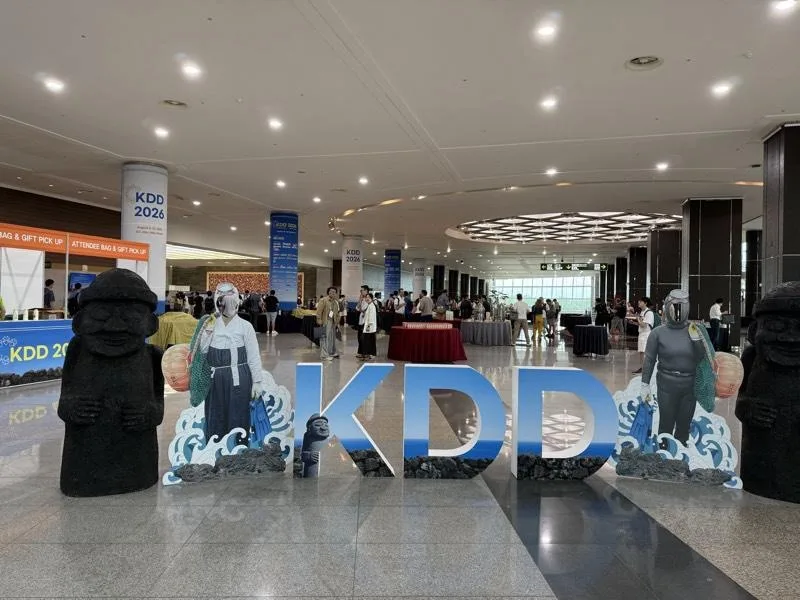
I attended the 32nd ACM SIGKDD Conference on Knowledge Discovery and Data Mining this August. It ran from August 9 to 13 on Jeju Island, South Korea. I was there through the Undergraduate Consortium, which accepts undergraduate research papers and brings the authors out to present them.
I presented my work comparing a multi-agent LLM approach to entity resolution against Magellan, which I used as the baseline. The projects section has more on it.
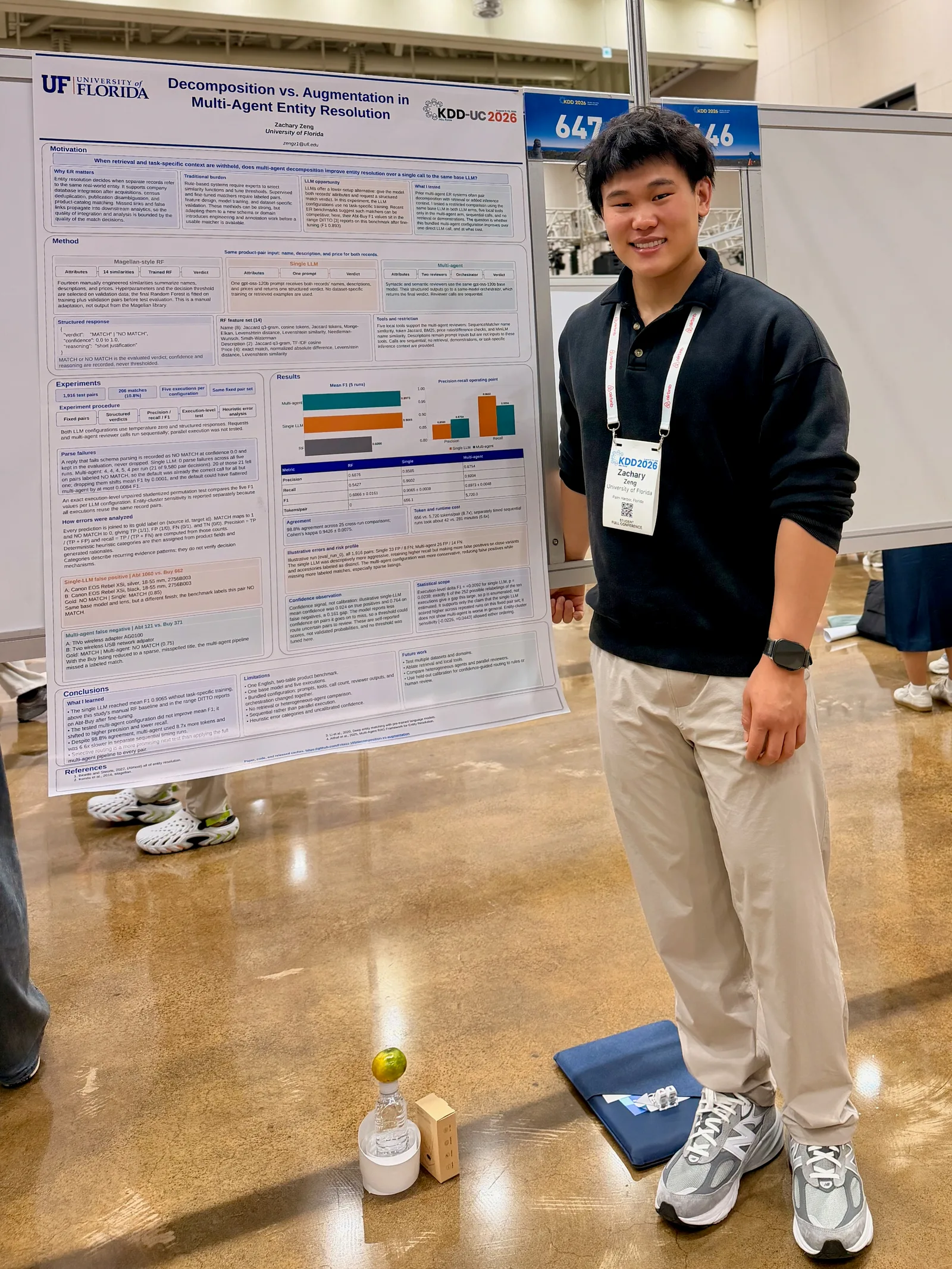
The poster session was Tuesday evening. All of the accepted Undergraduate Consortium papers were on display at the same time alongside the posters for the other research tracks. I was able to talk to a lot of people about my work and get feedback on it. I also got to see a lot of other research, which was a great learning experience to see how other people are approaching problems in the field.
My poster presentation experience
I learned a lot from the poster session. Much of it was from my observations of other presenters and their work. Some things that stood out were their experiment design and wide applications.
In experiment design, I noticed that almost every paper had an ablation study. An ablation study is where a researcher removes a component of their model to see how it affects the performance. This is a great way to show the importance of each component in a model. I had not done an ablation study in my work, and I realized that it was a normal expectation in this field.
In their applications, I saw machine learning being applied to a wide variety of fields. From airplanes to healthcare, I observed many projects trying to improve the state of the art in their respective areas.
The Undergraduate Consortium
The Undergraduate Consortium is more than the poster session. There were panel discussions on graduate school and on research careers, lunch with the academic and industry mentors we were assigned, and career preparation events.
This is the part I got the most out of. I attended without much knowledge of what a research career entails and was not even sure if I wanted one. The panel discussions gave me a much clearer picture about research as a career and the type of problems being solved.
Why I am interested in research
I personally enjoyed working on engineering problems from my internships and school projects. It was fun trying to build something to solve a problem in a way that fit a specification. But the work I find most interesting is finding a solution to a problem that is still ambiguous, where nobody has settled on the shape of the answer yet.
As a result, I am more open to the idea of pursuing a research career than I was before.
The part I have not figured out
I am still trying to figure out the specifics of what I want to do in the future. I know I want to work on interesting problems, but I am not sure about the exact path. I am already pursuing a Master's degree, so a PhD is not an obvious next step.
If difficult problems with ambiguous answers are what draw me, then I am not sure if I want to be in academia or industry. A lot of open-problem work happens inside companies, and it may not require a PhD.
I do not know what I want to pursue yet. I went to KDD expecting a clearer answer about graduate school and came back with a better question.